Monday, May 14, 2012

Dungeon Crawl Classics' Missing 250 Pages

I spent the weekend reading the new Dungeon Crawl Classics RPG. Topping out at 450 pages or so, it takes a bit of a commitment. Suffice to say that the game exceeds expectations. Goodman took a very old-school point of view and made a game that manages to offer a fresh perspective on many aspects of the game while loving maintaining all the core tenets of old school play. More importantly, the game doesn’t just provide rules, but it’s a primer on how to get the most out of its chosen style of play.

And the missing 250 pages are even better than the 450 the game provides!

Yeah, what’s that? The game’s missing about 250 pages. Let me explain:

One of the brilliant things about this style of play is the way that the core mechanics of characters, combat, magic, and treasure feed into the deeper realm that is each group’s unique experience of play without trying to define that experience. It’s always been my opinion that less is more in old-school rules, and that the simplicity of the rules is what forces groups to explore the rich ground that the rules don’t cover.

DCC addresses this through a series of interesting hooks in the character classes that explicitly point play in the direction of exploring this territory. Take the example of the thief. The thief’s alignment plays interestingly into their role in the world of thieves and society in general. A lawful thief is linked into the thief world through a crime family, guild, or gang. A chaotic thief is more likely an assassin, connected with more shadowy organizations, or perhaps working as a free agent. A neutral thief is more likely a mercenary, working along the borders of these groups for coin. A number of enticing sketches of potential thief organizations gives a great pointer for further directions of play. The other classes have similar hooks. The cleric has the uncertain relationship with their god. The fighter has heroic deeds and knightly orders to aspire too. The Dwarf has a complicated relationship with Dwarf society and the broader world. The Halfling has a strange and rich relationship with luck and the forces that guide it. The Elf has all of these to choose from. And the wizard has magical corruption, spellburn, and demonic patrons. These hooks are very wall laid out. The have the concise, leading language that Dungeon World and Apocalypse World do so well, and they are firmly rooted in the rich culture of old school.

But let’s talk about that wizard for a bit. As DCC tells us, low-level wizards fear for their lives, and high-level wizards fear for their soul. The hooks are designed to provide avenues to elaborate on that theme productively in play. Wizards have spellburn, enabling them to sacrifice some of their life force for temporary power. Magic carries inherent risk in terms of miscast and unpredictable effects. Most importantly, wizards have the option to find and develop a relationship with a magic patron, such as a demon, god, or extraplanar entity. As the wizard’s career advances, they will accrue unbelievable power, while also becoming more corrupted, compromised, and in the grip of horrible entities. The wizard’s story is the story of this struggle.

Mechanically, the elements of this story are woven into the spell descriptions, the sample wizardly patrons, the spellburn and casting mechanics, and bits of lore about the powers that make up the world. The wizard rules in DCC are a rich and morbid tapestry of power, risk, and reward.

All of which adds up to a good 50 pages of the DCC rules primarily focused on the story arc of wizards. We have some similar bits for clerics, woven into the spell descriptions and some tidbits about the gods. Thieves have a page with some hooks for thieves’ guilds. Elves have a few evocative passages of text. Which leads me to conclude that the rules are missing about 50 pages of awesome for every class. Writing 50 pages of awesome for the wizard and leaving the rest of the classes blank is the coolest and best and most interesting design choice by far in DCC RPG.

First off, the wizard pages are not, strictly speaking, mechanics. They are composed almost entirely of random tables and leading, sketched out content full of compelling blanks. They are an invitation to DMs to make wizards’ lives interesting, along with a whole lot of ways to do (more than you will ever, ever need no matter how many wizards you DM). The real rule here is “make the lives of wizards’ awesome, and if you’re not sure how to do that, use these tables.” The natural extension of this rule is “and do the same for all the other character classes in a similar vein.” Make the halfling’s life a long poker game played with Lady Luck. Play out the cleric’s dysfunctional relationship with their god in loving detail. Throw the world into stark contrast with Dwarf culture. Let the fighter re-make the world with her mailed fist. The game doesn’t tell you exactly how to do this, and that’s the point. The wizard pages are an example, and a particularly rich one informed by decades of play.

DCC RPG is the amazing D&D game that couldn’t be made until people had played D&D for 30+ years. If you’re already an old-schooler, you don’t need this game. But you will probably pick it up anyway because it’s so full of good stuff. I wouldn’t necessarily point someone to this tome over, say, Dungeon World, Modlvay D&D, Labyrinth Lord, or any of those, just because its length makes it seem more complex than it really is. I would recommend it, however, to anyone with a true love of D&D.

Labels: ,

Friday, June 3, 2011

High Quality Role Playing

It's Ben's game, but I love it. Here's the run down.

High Quality Role Playing (HQRP) is an old-school fantasy RPG where you play regular folks in a fantasy world dealing with the kinds of horrible threats that adventurers normally deal with. Yes, this means that you may be a tenant farmer facing off against a 1000 year old vampire or a blacksmith trying to con a dragon. If you’ve ever, say, had your first level Red Box D&D character fight a wolf, this isn’t that different. HQRP isn’t publicly released yet, but Ben tells me it’s “close”.

HQRP is laser focused on that kind of gritty, super tense old-school play where you’re armed with a pitiful array of feeble equipment and meager skills where absolutely every threat can kill you horribly in one blow.

Character generation is random and quite fun. There are no stats as such; instead you determine your social class and role and a few traits which then determine what your character is good at and what they own. The “good at” is relatively freeform. So, for example, Ben’s blacksmith, who is a war veteran and a coward is good at hammering things, appraising metal work, and lying down pretending to be dead. He has a spear and helmet. This is a pretty good character in HQRP. Jonathan’s character is a ditch digger. He’s good at digging and he has a shovel and a wheelbarrow. A few characters can do magic, though it’s always a rather risky kind of magic that typically requires you to do something costly or difficult, such as sacrifice your memories or pull out one of your own teeth.

There is also a random adventure generator that gives the basic location, situation, and enemy. For example, you might be on a mission in the forest facing wolves, or underground dealing with a dragon because of your own foolishness.

But the real beauty of HQRP is the resolution system, which is at once super simple and brilliant. To do normal things, you do them. When doing difficult things, you roll dice. Rolling dice is always risky, and while you can achieve great success, you can also fail horribly. You will almost certainly have to roll dice eventually, and doing so is a moment of delicious tension and possibility. Avoiding the dice roll is, however, just as fun as you strive to find a way to get over the pit or escape the town guard using only the mundane resources you have at hand. That’s the essence of HQRP.

Now the academic part. I look to The Old School Primer as my source on what old-school play is, so here’s how HQRP fits with the principles of the primer:

Rulings not rules: HQRP has a minimum of rules and they are purposely open to interpretation. For example, is a blacksmith good at enduring heat? Is swimming across a rushing river “difficult” or “insanely difficult”? The game emphasizes clear communication and discussion on these kinds of issues, resulting in a straightforward roll of the dice where everyone knows what’s at stake.

Player skill not character abilities: HQRP characters just aren’t that impressive. There’s no way what’s on your sheet is going to get you through alive, which forces the player to come up with creative solutions and then try to put them into action. This is fun.

Heroic, not super heroic: OK, yes, you’re playing a bunch of illiterate tenant farmers with no real weapons up against a horror older than time. True, you are probably going to die. But if you’re clever and lucky you might just pull through and score a treasure larger than any person in your village has ever imagined. To my taste, that’s pretty darn heroic.

Forget game balance: In one game, the opposition was wolves. They totally kicked our ass! In another game, the opposition was Satan. I actually got off pretty well in that game.

Labels: , ,

Monday, April 4, 2011

The Oeridia Map

I have this little corner of my mind called "The Greatest Fantasy Maps Ever." In that place I keep a little secret file of maps that I think represent truly amazing works of genius.

The Oeridia Dominions Map by Twan is one such map.


What makes it great isn't the artistic skill. If you look at a detail of the map, you'll see that the techniques are pretty rudimentary.


What makes the Oeridia Map great is its scope and completeness. The maker of the map had a clear vision which he fully executed using whatever tools he had at hand despite the fact that it must have taken a truly unreasonable amount of time. The same could still be said of a huge number of fan projects on the Net (I know I've made a few myself). But of them all, I like this one best.

The Oeridia Map is 9800 x 5700 pixels in size, yet it contains artistically rendered villages, bridges, and terrain features as small as 8x8 pixels. That's a pretty impressive information density. This map is big, and not just in terms of file size. Everything about it reinforces the bigness of the world it's portraying. This looks and feels like a world so big that you could only ever experience a piece of it in your lifetime. It helps to have played Dominions yourself, because just visiting every province on this map in a single game is probably impossible within practical limits.

Note also that an attempt has been made to make every province at least somewhat individualized. Some contain unique features. Terrain features are created using repeated icons, but these are mixed so that the regions do not contain just one kind of terrain. The arrangement and mix of trees, for example, is clearly intended to make each forest distinct.


But it's not obsessiveness that makes this map great (although that helps), but imagination. The way that the underworlds are rendered as a mix of natural caves and constructed places is inspiring (and probably helped inspire How to Host a Dungeon truth be told).

But I none of that explains why I get chills when I look at this map. I guess that really it's because the map feels like it's showing me a real place -- in just enough detail to feel real, with just enough mystery to make me wonder what it would be like to go there.

What this map is is what I want my games and my art to be: specific and detailed, but offering an endless horizon for exploration.

Labels: , ,

Friday, March 18, 2011

UFOs are Real? A Review of Mirage Men by Mark Pilkington

I have just finished reading Mirage Men: An Adventure into Paranoia, Espionage, Psychological Warfare, and UFOs.

I’m a UFO fan from way back, though I haven’t been any kind of true believer since I was 16.

The UFO movement is alive and well these days, though somewhat diminished since the days of X-files. Mirage Men purports to be a modern re-evaluation of the UFO legend. It’s a fine read full of both fascinating factual information and spectacular tall tales. Its primary goal is to chronicle the role that official disinformation, psyops, showmanship, and credulity have played in advancing the UFO legend–but with a shocking punch line.

Mirage Men offers a new narrative by which to read the UFO phenomenon. The central premise of the book is that various government agencies have at various times used the UFO community to disseminate disinformation in order to misdirect foreign and domestic eyes from black operations (like the B2 stealth bomber), while simultaneously priming and cultivating that community as a channel for disinformation. But Mirage Men ends with a fabulous disclosure, told in the best traditions of UFO inquiry, that a small group of dedicated individuals inside the System may be secretly priming the world for a true disclosure–one that is less fantastic than the tallest of UFO tales, but nevertheless something we are Not Yet Ready to Know.

Incidental to being a font of interesting stories, many of which I had never encountered before, Mirage Men could be a great sourcebook for a UFO-hunting story or RPG adventure. There is plenty of fuel here for a Men in Black style action adventure, an X-files exploration, or investigative spy game.

Labels: ,

Monday, February 14, 2011

Don Kenn and the Awesome of Post-It Notes

Don Kenn makes fabulous drawings on Post-It Notes. I mean it’s really fabulous stuff with monsters and places, and barely-hinted characters. It’s kind of like Edward Gorey and the Monster Manual and some other stuff thrown in.

There are these pictures of these horrible monstrosities just on the verge of devouring, cursing, or carrying away the hapless human denizens of Kenn’s world.


His technique is gorgeous. The gesture of the drawings is perfect. But what really gets me is the subtle way in which each picture shows something happening. It’s kind of subtle at first, but it’s never just a picture of some monster, next to some thing. It’s a monster reacting to that thing, with an expression that might be ravenous, but might be something else, like sorrow, or longing, or dread. Each picture sets up a relationship and a story.

I love this stuff. I just had to say that. Go check out his blog for more!

Labels: , ,

Saturday, October 16, 2010

Inked Adventures

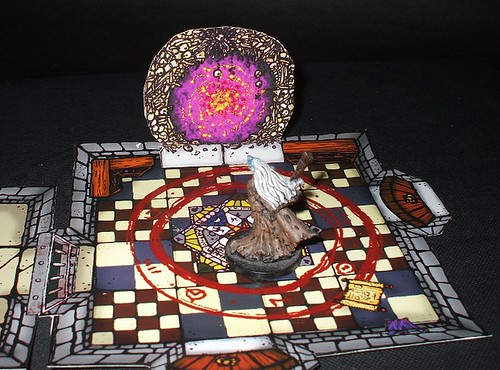
I'm really digging Inked Adventures dungeon tiles. They've got a stylish hand-drawn vibe that I like a lot. I've got nothing against the near photorealistic tiles that I've seen out there, but to me, D&D isn't about that aesthetic. These tiles make me want to play.
portal_hag_sml

Labels: ,

Thursday, September 9, 2010

PAX Wraup

So I went to PAX! Actually, just PAX Friday. One day is definitely not enough for a convention of PAX's scale. I had just enough time to do a reasonably thorough sweep of the convention floor and play some games before going home to crash into bed.

Dungeon World was the highlight for me. John Harper ran a foray into a sunken temple for me, Brandon, Will, and Craig. The Dungeon World rules are really coming together! It's a hack of Apocalypse World and D&D by Adam and Sage with moves from my own Apocalypse D&D project. I also got a demo of Dresden Files in with Ogre. Thanks Ogre!

Some of the stuff I saw on the Floor:
  • Torchlight 2 looks encouraging

  • End of Nations could be great. I hope the developers have played and learned from Shatered Galaxy.
  • And I bought Hegemony: Philip of Macedon on the spot. So far it lives up to the promise. It's like Empire: Total War, but with the focus on good grand campaign play. Tactical combat takes a back seat, but still presents enough options to be interesting.

Labels: , , ,

Tuesday, July 13, 2010

Play This Thing!

Play this Thing, which is an awesome game review Web site, reviewed my game How to Host a Dungeon for Tabletop Tuesdays last week. It's nice to see the game finding more players!

Labels:

Thursday, April 29, 2010

Fugitive Art


Home of: Richard Kimble by Mark Bennett is one of the greatest pieces of fantasy map art I’ve ever seen, and I encountered it hanging inside a Microsoft office building.* It’s also featured in Katharine Harmon’s book The Map as Art. Fantasy art and cartographic art get around.

I spent a little time before writing this trying to categorize this artwork using Wikipedia. It doesn’t fit Wikipedia’s description of lowbrow art; it’s not outsider art; nor is it truly naive art, since it clearly exploits an established body of technique. I guess the art world hasn’t yet gotten around to categorizing fantasy cartography, which is fine by me.

I want to talk about this picture a bit, just because I love it so much. It’s a map of the United States full of places which (presumably) really exist, ostensibly included as part of the fictional Richard Kimble’s real FBI file. And apparently Richard Kimble really got around, visiting every state except Mississippi and Hawaii. The map chronicles his adventures in those states. If you’ve watched every episode of The Fugitive, you’re probably more familiar with this fantasy United States that you are with the real one. But the fantasy United States isn’t pure fantasy. It’s deeply informed by the iconic regional experiences of the real United States:

“Cornell, ID. […] The Max Henderson Ranch (Mr. Kelly ranch hand) Eludes Sheriff Morgan Fallon and his posse on pack mules”

“Black Moccasin, NB. Ted Krumer’s new mechanic (Ben Rogers tractor driver) must flee to Bright’s Farm (Tyler County)”

“Crawford Farm (Mike Johnson field hand) protects Lt. Gerard from deadly pitchfork thrown by fellow fieldhands during storm”

So it’s a map of a TV show, but it’s also a map of our United States. In that sense, it’s as much a portrait of our world as, say Bruegel’s Landscape with the Fall of Icarus is a portrait fo Breugel’s world.

The map is also a technical triumph by any cartographical standard. It is executed 100% within the strict conventions of a functional map. It’s dense with detail. Each entry includes location, Richard Kimble’s alias at the time, the names of major protagonists, and the involvement of law enforcement in the scene.

But the map also purposely strains the limits of legibility. The closer you look, the harder it is to really make sense of the story. The entries are dangerously cramped in certain areas. The faint dotted lines that presumably mark the progress of the chase of Richard Kimble disappear behind the text, challenging you to follow them. When you look this close, the illusion that this map is a bare representation of fact begins to break down. You start to see disjunction between the real United States and the progress of a fictional journey.

But the illusion never breaks all the way. The map stays right on the line between the factual and the impossible, and that’s what makes this a really great fantasy map. It’s fun to look at, dense with information, flawlessly executed, thoughtful, and deeply informed by its subject matter: a truly great map.

* Microsoft has a spectacular art collection, including some stunning works that I'd call fantasy cartographic art.

Update E. Tage Larsen points out in the comments that this form of art can be properly termed Information Graphics or Information Design!

Labels: , , ,

Friday, March 19, 2010

D&D Audio and Video Actual Play

In my quest to really dig into the game of D&D I've been listening to (and watching) a lot of actual play lately. I can listen to it when I'm doing light editing and research work without it being too interruptive. Here's what I've found lately:

Expedition to the Ancient Academy is a raw recording of an OD&D campaign. I'm about half way through, and it's completely unedited. Expect 40 minutes of dice clattering sounds and muttered numbers as they make characters. Nevertheless there are some great moments of old-school fun.

Wil Wheaton, the Pvp guys, and the Penny Arcade guys play D&D. I haven't listened to this yet, but it has been billed as a great look at 4e.

I Hit it with my Axe is the new video show of Zak's D&D group (from Playing D&D with Porn Stars) playing. They're porn stars, but at the end of the day they're just a D&D group. That's pretty cool. Episode 1 OK, but I expect it to get much better with the upcoming episodes.

Labels: ,

Monday, March 15, 2010

Journey to the Membranous Labyrinth

I find that a good dungeon comes from an act of inspiration, drawn from the persistent ideas that I just can't otherwise get out of my head. I never expected to find a literal expression of this idea, but I have.

Squidman's Membranous Parasitic Dungeon is a micro dungeon literally inspired by an infection of the membranous labyrinth the Squidman carries in his own head (don't worry, I think that's just health-mage speak for an ear infection). I am terribly jealous.

The Labyrinth is a very serviceable little dungeon with a good hook to fit it into your campaign and the potential to bring an interesting change to that campaign in the future. It has a mix of encounters which can be approached in a number of different ways. There's also lots of scope for creepy mystery and suspense.

Labels: , ,

Tuesday, March 9, 2010

The AD&D Monster Manual is Awesome, A to B

I worked a bunch of exhausting 12-hour days this week, and to celebrate it's end I went up to my favorite coffee shop to read the AD&D Monster Manual and bring Read an RPG in Public Week to an end in style.

I'm trying to read this thing with new eyes and see what's really there, rather than what 20 years of gaming habits tell me is there. And the verdict is: I'm really amazed at how awesome the Monster Manual is.* Every monster is designed to bring something interesting and potential unique to an encounter; I'm not just talking about Beholders and Dragons, but the normal stuff that people often dismiss.

Consider the Aerial Servant: "if they grasp any creature it requires and 19 strength to have any chance of breaking free." Here's a monster than can potential seize any character in a nigh unbreakable grasp. I can think of about a hundred ways to make this awesome.

I love the behavorial tidbits that make each monster different. Baboons: "...if the home territory of a tribe is invaded the baboons will attempt to drive the invaders off, but it is 90% likely that the tribe will flee if faced by determined resistance." The power to run away sounds like a pretty lame power, right? But this detail shows that Gary knows what he's doing. It's a little piece of fiction (with a mechanic attached) to help the GM make this monster interesting and real for the players.

Boring beetles are pretty... well, boring!** Except for this: "...it is rumored that groups develop a communal intelligence which generates a level of consciousness and reasoning ability approximately that of the human brain." So Gary is saying that if you have a bunch of boring beetles and a big enough piece of wood (Giant Giant Sequoia? World Tree?), you've essentially got an insectile superbrain with beetle tunnels as analog circuitry and beetles as bits. So next time the blind druid directs the PCs to the "wise old tree" for information they PCs are in for a surprise. I wonder what quest the alien symbiotic hive mind will ask in return for that information.

Another thing: ever notice how many monsters can perform a valuable service for the PCs? Giant Beavers are massive builders. Brownies can fix stuff. I think this is a clear flag that talking to monsters ought to be at least as interesting as slaughtering them.

Basilisk can turn you to stone if you meet their gaze. How does this happen? There are no rules to tell you if, when you walk into a room with a basilisk in it, you meet its gaze. Some call this an incomplete game, I call it a golden opportunity to role play.

* These are the bad gaming habits I mean. 1E D&D: thinking that every monster's deadliness is it's first and only attribute of importance. 4E: thinking that the only thing about a monster that matters is what it's powers are. I've been guilty of both.

** This whole post is really just a response to Zak's post where he calls beetles boring. Shame on you Zak!

Labels: , ,

Thursday, February 18, 2010

Micro Review: Book of Ruins


Chris B pointed me to the old Judge's Guild Book of Ruins earlier today. The Book of Ruins is a collection of 10 "mini-dungeons" by Michale Mayeu, originally published in 1981. The dungeons vary in length from a short 4-room encounter, to a moderately large dungeon--big enough for 1-2 sessions of play. Most of the dungeons are on the short side, however, and are designed to be easily dropped into an existing campaign, or chained together as a mini-campaign.

I've got to say, I fell in love with this as soon as I started reading it. For me, it's the epitome of a good old-school product. The encounters are well thought out and obviously playtested. There's lot of room for interesting tactical positioning. The dungeons are obviously made to unfold in play. I can easily see each one unfolding in quite a different manner depending on the group, the path they take, and how they approach particular encounters.

One of my favorite things in a small dungeon is to see encounters where talking to the the monsters is an interesting option. It doesn't have to be a major option, but it's nice if it's there. Mayeu has obviously thought this out. The relationships between the monsters and their various dispositions are properly slotted into the text.

Some of the encounters are a little stock. There are no less than three dungeons where an Ogre is a prominent villain, with a group of lesser humanoids around him. If I were running it, I would substitute more varied denizens. This was also published in 1981, and reflects its time. If you're looking for skill-based challenges or epic storylines, you won't find it here, though you could probably add it yourself.

Tactical challenge and simulation are clear goals in this product. One of the larger adventures is a carefully designed encounter with a powerful stock magical monster. The author has clearly designed this encounter based on a frustration with poorly designed similar encounters he's seen in other products. The result is a particularly nasty and challenging fight. This is completely appropriate in this kind of product, possibly even essential to challenge high-level parties, but groups that aren't expecting it will be in for an unpleasant surprise.

The Book of Ruins is available on RPGnow, and is a bargain at $4.00.

Labels: